Writing
Field notes, with receipts
What AI systems really cost, who owns that cost, and how to keep quality up when AI speeds up delivery. Long-form here; shorter essays on Medium.
Series
Human in the Loop
Field notes on managing AI-assisted software delivery: how I scope the work, what I check before anything ships, and the bugs that got through anyway.
See all 10 parts- 01 TendForm: managing a solo SaaS build to production quality
- 02 TrendVesting: validating 2.5 years of production AI
- 03 TigerMill: quality gates for an AI content pipeline
- 04 Your permission allowlist is an org chart Soon
- 05 Instructions rot faster than code Soon
On this site
-
Sep 15, 2026 · 11 min
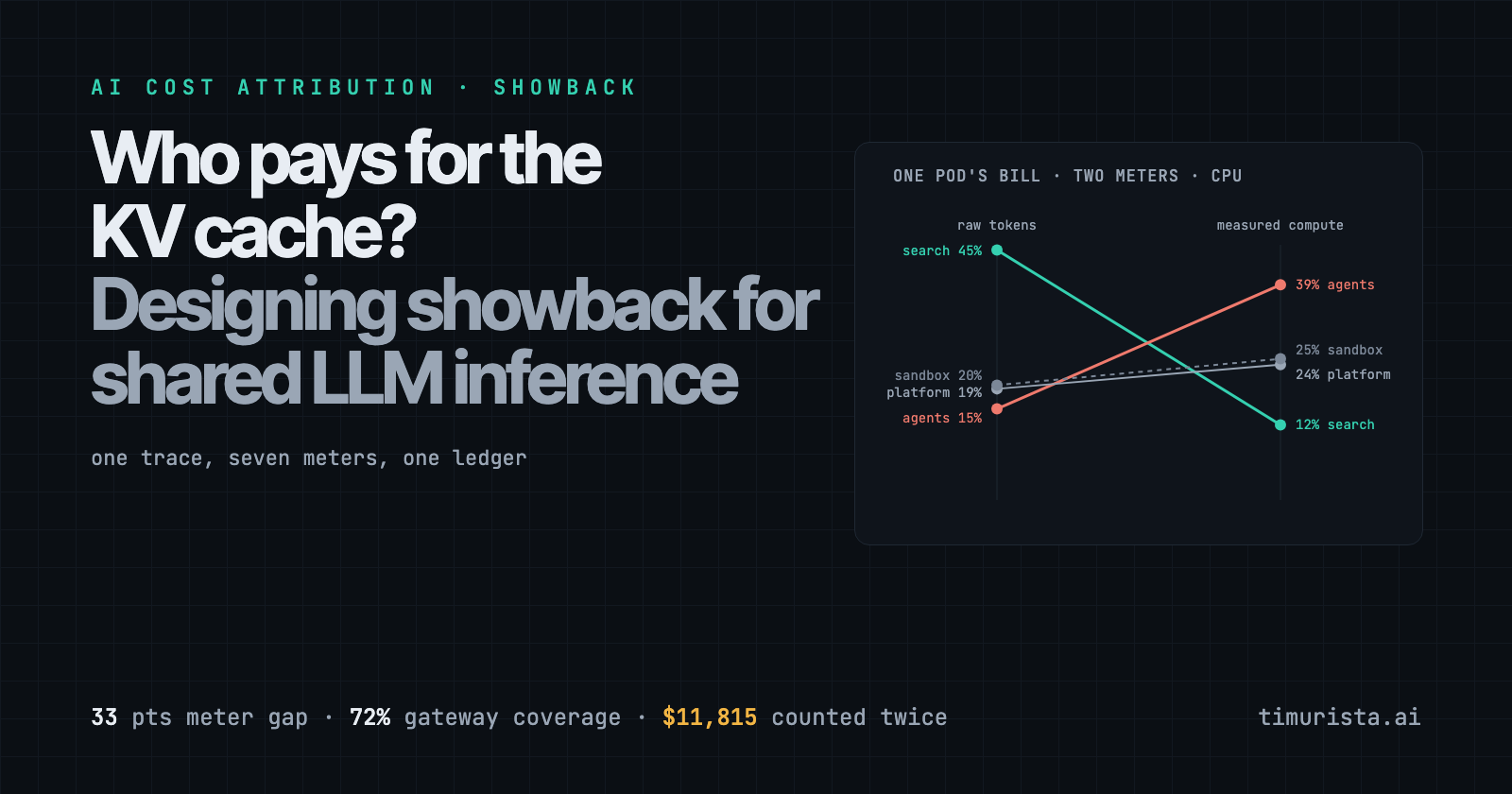
Who pays for the KV cache? Designing showback for shared LLM inference
A guide for platform and FinOps leads who have to split shared AI spend: which meter to charge by, where idle capacity goes, how to give every dollar one path into the ledger, and what a joined ledger can answer. Backed by measurements from unalloc, my open-source cost-attribution tool.
-
Sep 14, 2026 · 11 min · Part 9
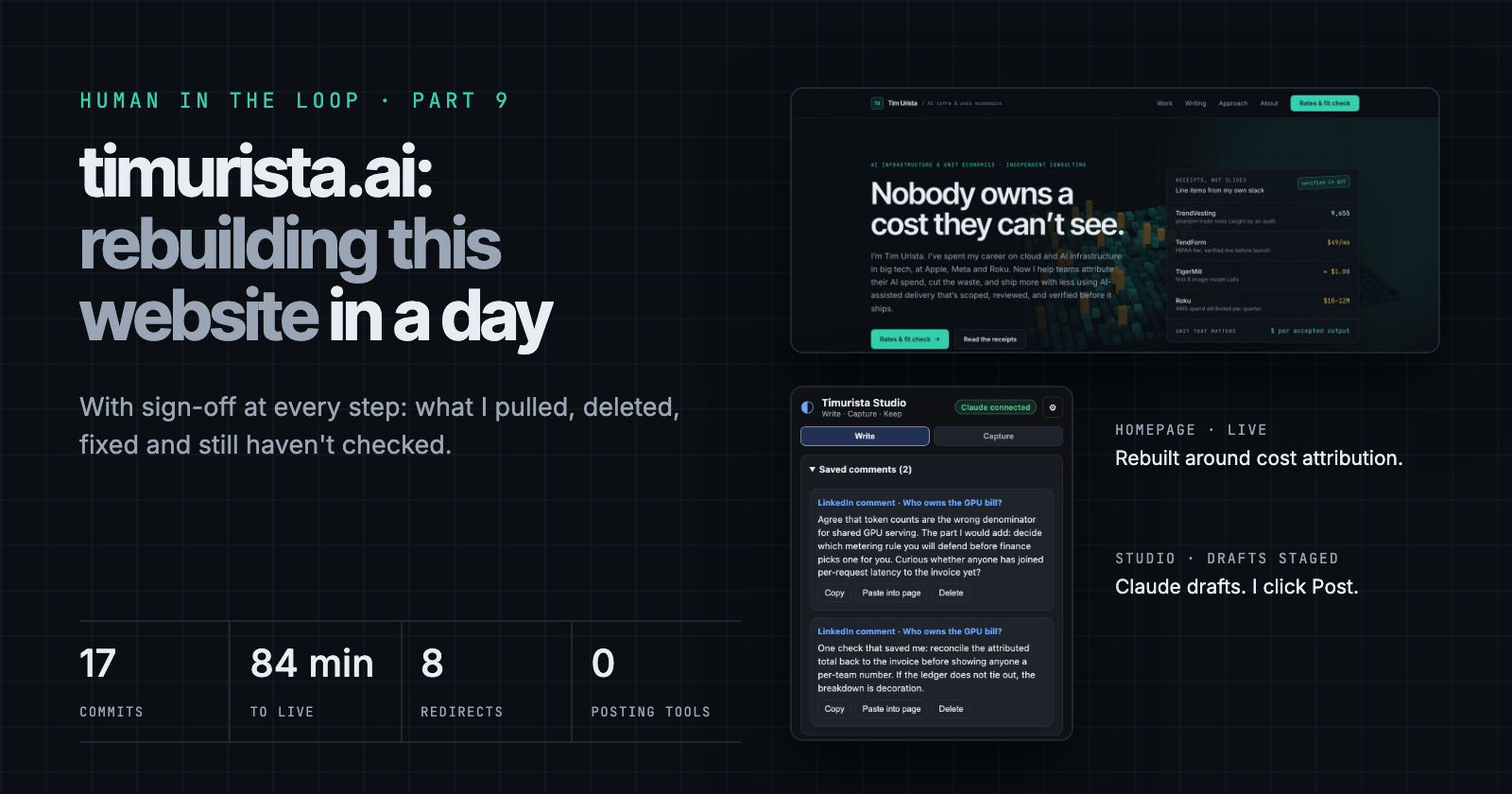
timurista.ai: rebuilding this website in a day, with sign-off at every step
How I scoped, reviewed and shipped the rebuild of this site: a framing I pulled back within the hour, numbers I deleted because I couldn't source them, a form that showed my phone number to the wrong people, and a retired Worker route that quietly shadowed the new API.
-
Sep 14, 2026 · 11 min · Part 10
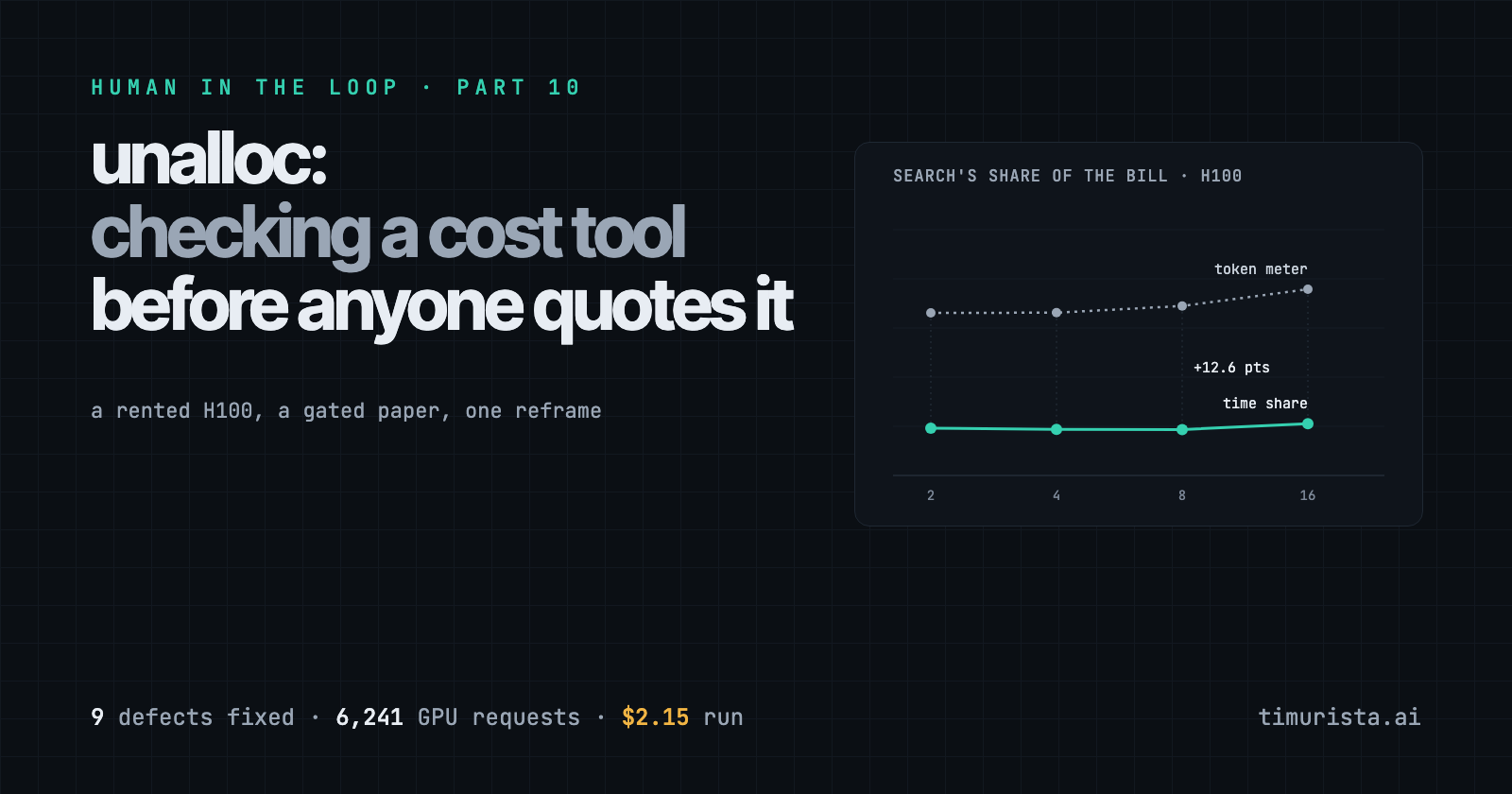
unalloc: checking a cost-attribution tool before anyone quotes its numbers
How I scoped and checked unalloc, an open-source tool that joins Kubernetes and LLM provider bills: nine defects caught before release, a budget-capped H100 run with a verified teardown, a paper build that refuses silent typos, and a headline I softened because no meter is ground truth.
-
Sep 13, 2026 · 11 min · Part 1
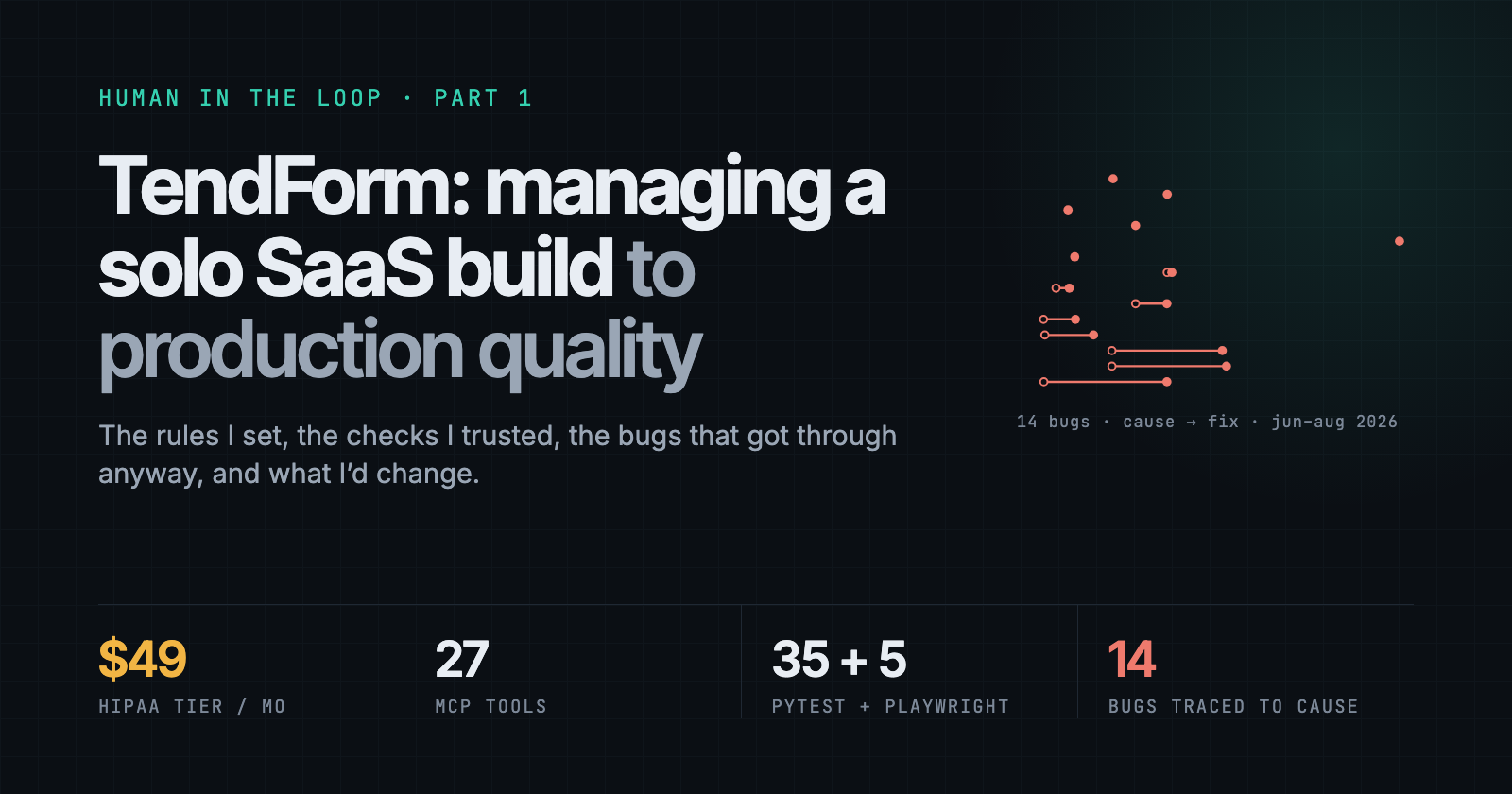
TendForm: managing a solo SaaS build to production quality
How I scoped, reviewed and validated a HIPAA-capable form builder I built alone: the rules I wrote down, the checks I trusted, the 14 bugs that got through anyway, and the process I'd change.
-
Sep 13, 2026 · 11 min · Part 2
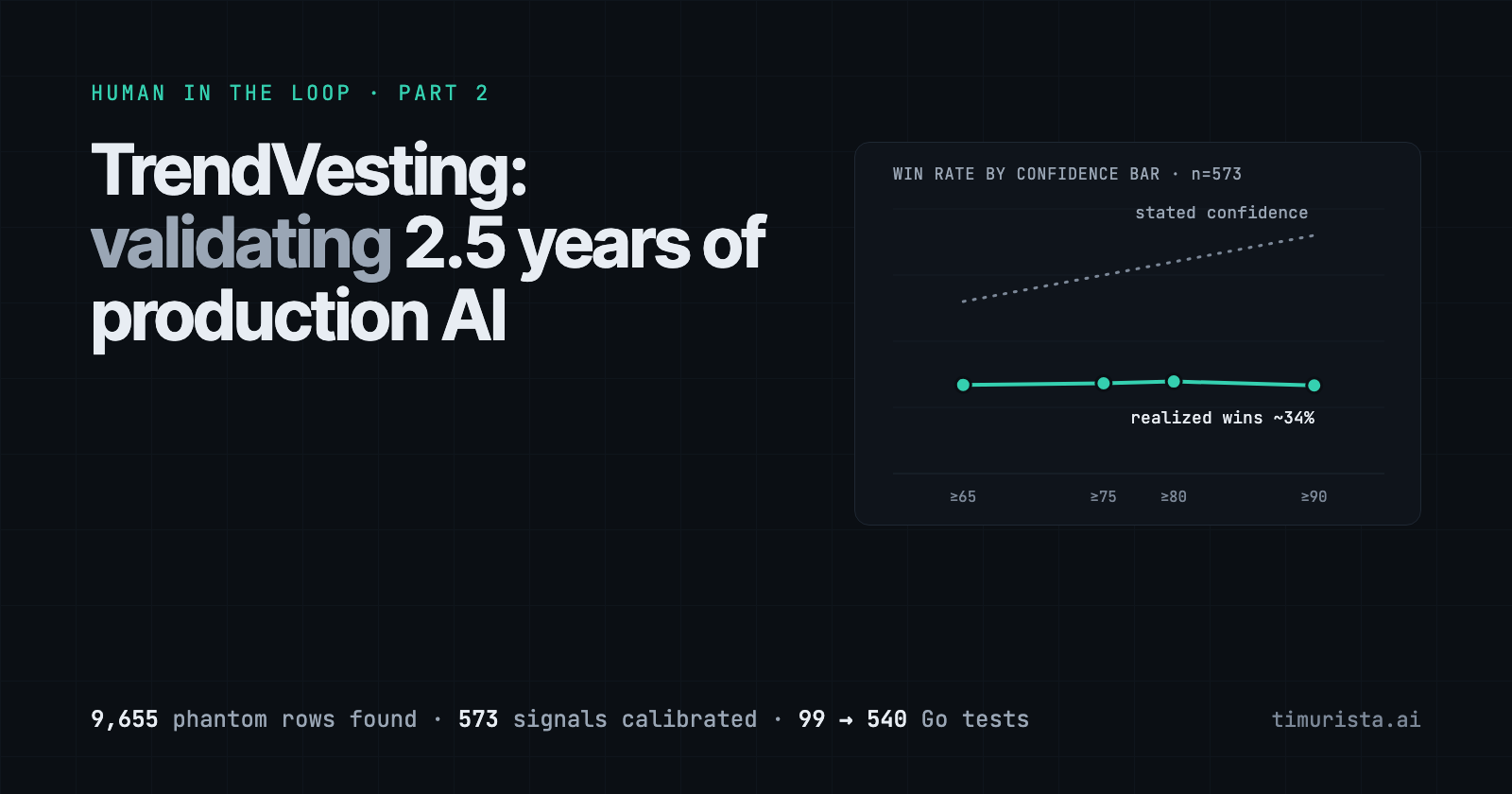
TrendVesting: validating 2.5 years of production AI
How I review and validate an AI trading system I own: change records with production numbers, invariant tests, reconciliation audits and calibration checks, and the numbers they overturned.
-
Sep 13, 2026 · 11 min · Part 3
TigerMill: quality gates for an AI content pipeline
How I defined acceptance for a novel-to-webtoon pipeline: a gate after every stage, approvals that name who made them, spend behind a human trigger, and tests that guard the defects I already paid for once.

On Medium
All essays →-
DevSecOps & AI · 11 min
Unexpected Costs of Fragmented AI Governance
Governance sprawl is a hidden cost center: every disconnected policy, tool, and review adds spend nobody attributes back to it.
-
DevSecOps & AI · 7 min
The FinOps Tax on AI Engineer Salary Premiums
The cost of AI talent is itself a line item most orgs never attribute, and it quietly reshapes unit economics.
-
AI Advances
Beyond Tokens: How Byte Latent Transformers Are Solving the $10B Language Model Crisis
Tokenization is a hidden tax on every model. How byte-latent transformers attack the cost problem at the architecture level.
-
DevSecOps & AI · 6 min
Your Gateway Filter Stops the Honest User and Annoys the Attacker
A threat-model read on AI gateway filtering: who your controls actually stop, and who they merely inconvenience.
-
TechFlows · 16 min
The AI Productivity Paradox
Why more developer tools are making us less effective, and how tooling sprawl shows up on the invoice.
-
TechFlows · 23 min
How Deleting Code Is Becoming the Premium Engineering Skill
The highest-leverage move is often subtraction: removing code, and the cost that comes with it.
-
TechFlows · 6 min
Why Your Micromanaging Boss is Actually Broken Code
A debugging metaphor for dysfunctional management: trace the inputs, find the broken function, ship a fix.